
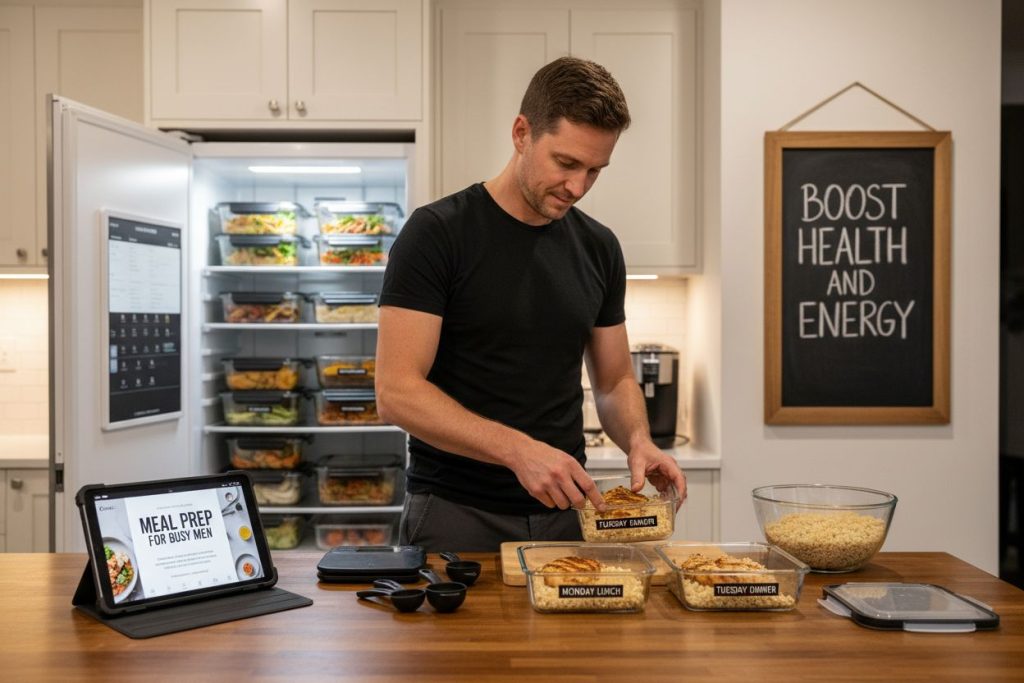
Short answer: Meal prep for beginners comes down to one planning session and one or two cooking blocks a week: cook a couple of proteins, a whole grain, a tray of vegetables and a few grab and go items, then portion them into shallow containers. Cooked leftovers keep 3 to 4 days in a refrigerator set at 40°F or below, so plan a quick midweek top up or freeze the second half of the week. Build each box on the plate model: about half vegetables and fruit, a quarter whole grains, a quarter protein.
Key Takeaways
- Start small: prep lunches for Monday to Thursday before you try to prep every meal of the week.
- USDA and FoodSafety.gov put cooked meat, poultry and soups at 3 to 4 days in the fridge, so food cooked on Sunday should be eaten by Wednesday or Thursday or frozen.[1][2]
- Refrigerate cooked food within 2 hours (1 hour if it is above 90°F) and cool it in shallow containers.[2]
- Reheat every prepped meal to 165°F, checked with a food thermometer in more than one spot.[2][3]
- MyPlate gives adult men 6 to 7 ounce equivalents of protein foods, 2.5 to 3 cups of vegetables and 2 cups of fruit per day as a general starting point.[4]
- A simple template (protein + whole grain + two vegetables + a sauce) beats a complicated recipe list for staying consistent.
What Meal Prep Actually Means (and Why Beginners Quit)
Meal prep is cooking some or all of your week’s food in advance so that a healthy option is always faster than ordering in. It comes in three common styles:
- Full meal boxes: complete meals portioned into containers, ready to reheat. Best for workday lunches.
- Ingredient prep: you cook components (chicken, rice, roasted vegetables, a sauce) in bulk and assemble different meals each day. Best if you get bored easily.
- Batch and freeze: you make a large pot of chili, soup or stew and freeze single portions. Best for nights when you do not want to cook at all.
Most beginners quit for two reasons: they try to prep 21 meals in their first weekend, and they cook seven days of food at once, so the Friday box is unappetizing or past its safe window. The fix is to prep fewer meals, use a mix of fresh and frozen portions, and follow the storage rules below.
How to Meal Prep for Beginners: A 5 Step System
Step 1: Pick your target meals
Choose the meal you most often get wrong. For most busy men that is lunch at work or a late dinner. Prep that one meal for four days first. Breakfast is the easiest second target, because eggs, oats and yogurt need little cooking.
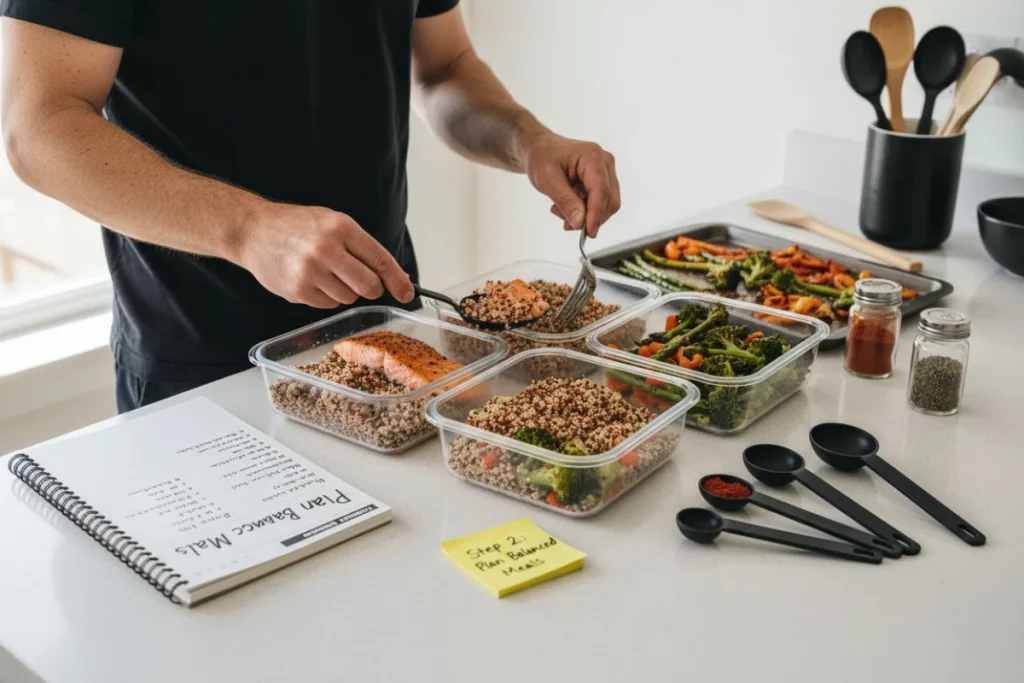
Step 2: Use a plate template, not a recipe book
The Harvard T.H. Chan School of Public Health’s Healthy Eating Plate is a simple layout for every container: make about half of it vegetables and fruit, a quarter whole grains and a quarter healthy protein. It also advises choosing healthy plant oils such as olive or canola, limiting red meat, avoiding processed meats like bacon and sausage, and drinking water, coffee or tea.[5] Note that the Healthy Eating Plate does not count potatoes as a vegetable because of their effect on blood sugar.[5]
Step 3: Write one shopping list
Plan the week before you shop. A beginner list usually needs only two proteins (for example chicken thighs and lean ground turkey), one or two whole grains (brown rice, oats, quinoa or whole wheat pasta), three or four vegetables that roast well (broccoli, peppers, carrots, zucchini), a bag of salad greens, fruit, eggs, plain yogurt and one or two sauces. Buying a short list of ingredients you reuse is what keeps meal prep cheap.
Step 4: Cook in parallel, not in sequence
In a 90 minute block, the oven, stovetop and rice cooker should all be working at the same time:
- Preheat the oven and put grains on the stove or in a rice cooker.
- Season the protein and put it on one sheet pan; put chopped vegetables on a second pan.
- While those cook, hard boil eggs, brown ground meat for a chili or bowl, and mix a sauce.
- Check doneness with a thermometer: poultry 165°F, ground meat 160°F, steaks and chops 145°F with a 3 minute rest, fish 145°F.[3]
- Spread hot food into shallow containers so it cools quickly, then refrigerate within 2 hours.[2]
Step 5: Label, store and rotate
Write the cooking date on every container. Eat the oldest boxes first, and move anything meant for Thursday or Friday straight into the freezer on prep day. Thaw frozen portions in the refrigerator, in cold water or in the microwave, never on the counter.[2]
Sample Weekly Meal Prep Plan for Busy Men
This plan uses one main prep session on Sunday and a 30 minute top up on Wednesday so nothing in the fridge goes past the 3 to 4 day window. Adjust portions to your size, activity and goals.
| Day | Breakfast | Lunch (prepped box) | Dinner | Prep note |
|---|---|---|---|---|
| Sunday | Eggs and fruit | Fresh meal | Fresh meal | Main session: roast chicken thighs, cook brown rice, roast 2 trays of vegetables, hard boil 8 to 10 eggs, make a pot of turkey and bean chili, portion overnight oats |
| Monday | Overnight oats + berries | Chicken, brown rice, roasted broccoli and peppers | Turkey chili + side salad | Eat Sunday food first |
| Tuesday | 2 hard boiled eggs + yogurt + fruit | Chicken grain bowl with greens and sauce | Turkey chili + vegetables | Freeze 2 to 3 chili portions for next week |
| Wednesday | Overnight oats + nuts | Last Sunday chicken box | Fresh sheet pan salmon + vegetables | Top up: cook salmon or tofu and a new batch of grains and vegetables for Thursday and Friday |
| Thursday | Eggs + whole grain toast | Salmon or tofu, quinoa, roasted vegetables | Frozen chili portion, reheated to 165°F | Check dates on every box |
| Friday | Yogurt + fruit + oats | Wednesday batch bowl | Flexible meal out | Clear the fridge, plan next week |
| Saturday | Flexible | Leftover vegetables in an omelet or wrap | Flexible | Shop for Sunday |
If you want more structure around protein targets, see our guide to how much protein men need per day.
How Long Does Meal Prep Last in the Fridge?
This is the question that decides whether your system is safe. The figures below come from the FoodSafety.gov cold storage chart and the USDA Food Safety and Inspection Service.[1][2] Keep the refrigerator at 40°F (4°C) or below and the freezer at 0°F (minus 18°C) or below.[1]
| Food | Refrigerator | Freezer |
|---|---|---|
| Cooked meat or poultry leftovers | 3 to 4 days | 2 to 6 months |
| Soups and stews with meat or vegetables (chili included) | 3 to 4 days | 2 to 3 months |
| Chicken, tuna, egg or macaroni salad | 3 to 4 days | Does not freeze well |
| Hard cooked eggs | 1 week | Do not freeze |
| Raw ground meat or poultry (before cooking) | 1 to 2 days | 3 to 4 months |
| Raw chicken pieces (before cooking) | 1 to 2 days | 9 months |
Two practical points follow from this chart. First, buy raw chicken and ground meat close to prep day, because they only last 1 to 2 days raw in the fridge. Second, freezer times are about quality, not safety: USDA notes frozen leftovers are safe indefinitely but lose moisture and flavor over time.[2] The chart does not list cooked rice or pasta separately, so treat them like other leftovers and use them within 3 to 4 days.
Cooling and reheating rules
- Refrigerate cooked food within 2 hours, or within 1 hour if the air is above 90°F, for example in a hot car.[2]
- Divide large batches into shallow containers so the center cools fast.[2]
- Reheat to 165°F. Microwaves have cold spots, so cover the food, stir or rotate it, and check the temperature in several places.[2][3]
- When in doubt, throw it out. Smell is not a reliable safety test.
Portions: How Much Should Go in Each Container?
MyPlate gives general daily amounts for adult men who are not very active. They are a starting point, not a prescription; larger, more active men usually need more.[4]
| Food group | Men 19 to 30 | Men 31 to 59 | Men 60+ | What counts as one unit |
|---|---|---|---|---|
| Protein foods | 6.5 to 7 oz equivalents | 6 to 7 oz equivalents | 5.5 to 6.5 oz equivalents | 1 oz cooked chicken, meat or fish; 1 egg; 1/4 cup cooked beans or tofu |
| Grains | 8 to 10 oz equivalents | 7 to 10 oz equivalents | 6 to 9 oz equivalents | 1/2 cup cooked rice, pasta or oatmeal; 1 slice of bread |
| Vegetables | 3 cups | 3 cups (2.5 cups from 51) | 2.5 cups | 1 cup of vegetables; 2 cups of raw leafy greens count as 1 cup |
| Fruit | 2 cups | 2 cups | 2 cups | 1 cup of fruit |
MyPlate also advises that at least half of your grains be whole grains.[4] In practice, a lunch box with about 4 ounces of cooked chicken, 1 cup of cooked brown rice and 1.5 cups of vegetables covers a large share of a man’s daily protein, roughly a quarter of his grains and half his vegetables.
The newer Dietary Guidelines for Americans, 2025-2030, published on RealFood.gov, emphasize whole foods, recommend avoiding highly processed foods and added sugars, and list a protein range of 1.2 to 1.6 grams per kilogram of body weight per day.[6] A home prepped box built from whole ingredients fits that direction better than most takeout.
Beginner Mistakes to Avoid
Cooking everything on Sunday
With a 3 to 4 day fridge window, a Sunday only prep cannot safely cover Friday unless some portions are frozen. Split the week or freeze.
Same meal, every day
Ingredient prep solves this: the same chicken becomes a rice bowl on Monday, a salad on Tuesday and a wrap on Wednesday with different sauces. See our notes on mindful eating if you tend to eat lunch at your desk without noticing it.
Dry, overcooked protein
Use a thermometer and pull food once it reaches the safe temperature instead of guessing. Chicken thighs stay moister than breasts after reheating.
Forgetting snacks and training days
Hard boiled eggs, yogurt, fruit and nuts are the easiest prepped snacks. If you train hard, our guide on what to eat before a workout covers meal timing around training.
Where Supplements Fit (and Where They Do Not)
Meal prep is the foundation: a supplement cannot make up for a week of vending machine lunches. Some men add a supplement on top of a solid diet. Ultra Bann, made by DL Bioproducts, is a natural male vitality supplement taken as one capsule every 2 days. Each 800 mg serving lists seven botanicals with their amounts and no proprietary blend: Thai Butea superba, Panax ginseng, Cynomorium songaricum, black ginger, tongkat ali, epimedium and reishi. You can review the full ingredient label or visit the shop. Talk with your doctor before adding any supplement, especially if you take prescription medication.
Frequently Asked Questions
How long does meal prep last in the fridge?
Cooked meat, poultry, soups and stews keep 3 to 4 days at 40°F or below, according to FoodSafety.gov and USDA. Hard cooked eggs keep about 1 week. Freeze anything you will not eat within that window.
Is it safe to meal prep for 5 days?
Not if all five days of cooked food sit in the fridge from day one. Prep for 3 days, freeze days 4 and 5, or do a short midweek cook. Frozen portions should be thawed in the fridge and reheated to 165°F.
What should a beginner meal prep first?
Start with four workday lunches built on one protein, one whole grain and two vegetables. Once that feels routine, add breakfast (overnight oats or hard boiled eggs) and then a freezer friendly dinner such as chili.
How much food should be in a meal prep container for a man?
A practical lunch for a moderately active man is about 4 to 6 ounces of cooked protein, 1 cup of cooked whole grains and 1 to 2 cups of vegetables. Adjust up or down based on hunger, training and body weight goals; a registered dietitian can set exact numbers.
Can you freeze meal prep with rice?
Yes. Cool it quickly in shallow containers, freeze it, and reheat to 165°F. Expect some texture change; adding a little water before microwaving helps.
References
- FoodSafety.gov (U.S. Department of Health and Human Services). Cold Food Storage Chart.
- USDA Food Safety and Inspection Service. Leftovers and Food Safety.
- FoodSafety.gov. Cook to a Safe Minimum Internal Temperature.
- USDA MyPlate. Protein Foods, Grains, Vegetables and Fruits.
- Harvard T.H. Chan School of Public Health, The Nutrition Source. Healthy Eating Plate.
- RealFood.gov. Dietary Guidelines for Americans, 2025-2030.
These statements have not been evaluated by the Food and Drug Administration. This product is not intended to diagnose, treat, cure or prevent any disease. This article is for information only and is not medical advice.
Ultra Bann natural male vitality support
1 capsule every 2 days. Free US shipping and a 60-day money-back guarantee on your first order.
See Ultra BannThese statements have not been evaluated by the Food and Drug Administration. This product is not intended to diagnose, treat, cure, or prevent any disease.