
Short answer: The best supported schisandra benefits for men are modest help with physical and mental fatigue and, in two small 12 week trials in adults over 50, better leg strength. Most other claims (liver protection, brain protection, sexual function) rest mainly on animal and lab studies. Schisandra is generally well tolerated, but it changes how the liver processes several prescription drugs, so check with a doctor or pharmacist first if you take any regular medication.
Key Takeaways
- Schisandra (Schisandra chinensis, “five flavor berry” or wu wei zi) is a vine berry used in Traditional Chinese Medicine and in Russian sports and military medicine as a tonic and adaptogen.
- A 2009 review in Current Clinical Pharmacology rated the evidence that schisandra improves endurance and mental performance in people with mild fatigue as “good,” one step below the strongest category.[1]
- In a randomized, placebo controlled trial, 1,000 mg a day of schisandra extract for 12 weeks raised quadriceps strength by about 7.7% in postmenopausal women, with no change in muscle mass.[2]
- Claims about testosterone, erections or fertility in men have no human evidence behind them so far.
- The main safety issue is drug interactions: schisandra raised blood levels of tacrolimus, midazolam and talinolol in clinical studies.[3][4]
What Is Schisandra?
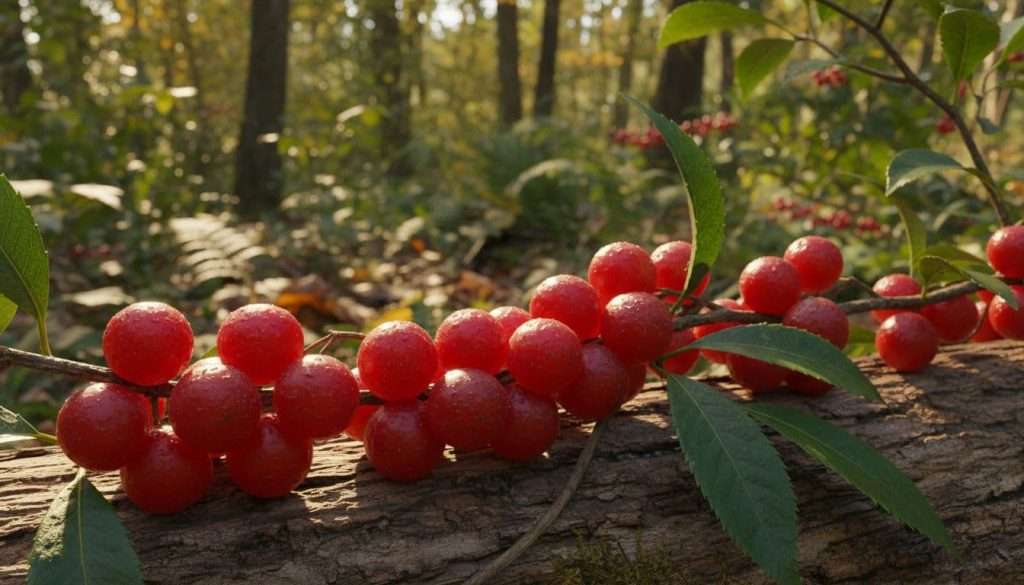
Schisandra chinensis is a woody vine native to northern China, Korea and the Russian Far East. Its small red berries are dried and used whole, as tea, as powder or as standardized extract. The Chinese name wu wei zi means “five flavor fruit,” because the berry tastes sweet, sour, salty, bitter and pungent at once.
In Traditional Chinese Medicine, schisandra has been used for cough, sweating, indigestion, liver complaints and as a general tonic for strength and stamina.[3] In Russian and Soviet research it was studied as an “adaptogen,” a term for plants thought to help the body resist physical and mental stress, mainly for fatigue and endurance.[1]
The active compounds
The compounds researchers care most about are lignans, a family of plant chemicals that includes schisandrin A, schisandrin B, schisantherin A and the gomisins.[3] A 2025 review in Chinese Medicine describes antioxidant, anti-inflammatory, neuroprotective and liver protective effects of these lignans, but it also points out that they are poorly absorbed and quickly metabolized, which limits how much reaches the tissues after you swallow them.[5] That gap between strong lab activity and weak absorption is one reason results in people tend to be smaller than results in test tubes.
Schisandra Benefits: What the Evidence Shows
When you read about schisandra benefits online, the claims often blend human trials, rodent studies and cell experiments as if they were the same thing. They are not. The table below separates them.
| Claimed benefit | Type of evidence | What was found | Strength |
|---|---|---|---|
| Mental fatigue and endurance | Human trials, mostly older and nonrandomized | Better endurance and mental performance in people with mild fatigue; a systematic review graded it B for mental fatigue | Moderate |
| Muscle strength | Two randomized, placebo controlled trials in adults 50 and over | Stronger quadriceps after 12 weeks of 1 g extract daily; no gain in muscle mass | Moderate, small samples |
| Single dose mental performance | Human trial of a combination product | Improved performance on cognitive tasks versus placebo | Limited, schisandra not tested alone |
| Liver health | Small human studies, many animal studies | Lower ALT and AST liver enzymes in some studies | Limited in humans |
| Memory and brain protection | Mouse and cell studies | Memory improvements in mice; antioxidant effects in cells | Animal only |
| Testosterone, erections, fertility | Animal tissue only | No human data found | Not established |
Fatigue, stamina and mental performance (human data)
The strongest case for schisandra is fatigue. Panossian and Wikman, reviewing the clinical literature on adaptogens in 2009, concluded that trials showed good evidence that schisandra and eleuthero increase endurance and mental performance in patients with mild fatigue and weakness.[1] A systematic review summarized by Drugs.com graded schisandra B for mental fatigue, based on 7 nonrandomized single dose trials with 1,712 participants and one repeated dose trial with 665 participants.[4]
The weakness is study quality. Most of these trials are decades old, few were randomized, and evidence levels ranged from IIa to III.[4] So the honest summary is “promising and consistent, but not proven to modern standards.”
Muscle strength (human data)
Two Korean trials are the most modern human evidence. In the first, 45 postmenopausal women (average age about 62) took 1,000 mg of schisandra extract or a starch placebo every day for 12 weeks. Quadriceps strength rose by about 7.7% in the schisandra group and did not change with placebo, and resting lactate dropped. Grip strength, walking speed, chair stands and muscle mass did not differ between groups.[2] A second trial using the same dose in 67 healthy adults aged 50 and older also found greater muscle strength than placebo after 12 weeks, again without a change in muscle mass.[4]
For men, this is the most relevant finding: a modest strength benefit in older adults, not a muscle building effect. The authors of the first trial noted that diet and physical activity were not tracked, and the samples were small.[2]
Liver and brain (mostly animal data)
Schisandra has a long reputation as a liver herb. In humans, a small study of schisandra extract combined with sesamin reported improved liver function markers, and schisandra can lower the liver enzymes ALT and AST on blood tests.[3] That matters if you get routine bloodwork: a lower number may reflect the herb, not a change in the underlying condition. Claims about memory, nerve protection and mood come mainly from mice and cell cultures.[3][5]
Sexual health and testosterone (no human data)
Some websites say schisandra raises testosterone or improves erections. We could not find a single human trial supporting either claim. The only related research is in isolated rabbit tissue, where two schisandra compounds strengthened the relaxing effect of a prescription drug on erectile tissue.[4] That is a lab finding, not evidence that the berry does anything for men on its own. If you have concerns about erections or hormone levels, see a doctor: both can be early signs of heart, metabolic or hormonal conditions that deserve a proper workup. Our guide to signs of low testosterone explains what to ask about.
How Schisandra Is Thought to Work
Memorial Sloan Kettering’s monograph states plainly that scientists do not fully know how schisandra works.[3] The proposed mechanisms include:
- Antioxidant activity: lignans raise glutathione and other protective enzymes in animal and cell studies.[3]
- Calming inflammation signals: lab studies show inhibition of NF kappa B and MAPK, two pathways that switch on inflammation.[3]
- Stress response modulation: adaptogen researchers link schisandra to molecular pathways involved in stress protection, though this comes mostly from experimental models.[1]
- Liver enzyme effects: schisandra inhibits the CYP3A drug processing enzymes and the P-glycoprotein transporter, which explains its drug interactions.[3][4]
Schisandra Dosage: How Much Has Been Studied
There is no official dose. These are the amounts used in research and traditional practice:[2][4]
- Standardized extract: 1,000 mg a day (split into two doses) for 12 weeks in the muscle strength trials.
- Dried, powdered fruit: 1.5 to 6 g a day as an adaptogen.
- Russian official preparations: 0.5 to 1.5 g of dried fruit twice daily, or 20 to 30 drops of fruit tincture twice daily.
Products vary a lot in lignan content, so a 500 mg capsule from one brand is not equal to 500 mg from another. Look for an extract that states its standardization and a brand that uses independent lab testing (see our guide to third party tested supplements). Because the fatigue research suggests a mild stimulating effect and overdose reports include restlessness and insomnia, many people take it in the morning or early afternoon rather than at night.[4] Good sleep habits will do more for daytime energy than any berry; see our sleep routines for men.
Side Effects and Drug Interactions
Common side effects
Schisandra appears well tolerated in short term studies. No serious side effects have been reported, although the herb has not been studied extensively in people.[3] The most commonly listed side effects are heartburn and upset stomach. Allergic reactions are possible: stop taking it and get help right away if you notice swelling of the face or throat, hives or trouble breathing.[6]
Drug interactions (the real risk)
Schisandra can change how the liver clears medications. In clinical studies it increased drug exposure about 2.1 fold for tacrolimus, 2 fold for midazolam and 1.5 fold for talinolol. In 64 kidney transplant patients, those taking schisandra needed a 34% lower tacrolimus dose after 6 months, compared with 14.3% in those not taking it.[4] It may also speed up the breakdown of warfarin.[4]
Many common prescription drugs are cleared through the same CYP3A4 pathway. Memorial Sloan Kettering advises against schisandra if you take drugs processed by CYP1A2, CYP3A4, CYP3A5 or P-glycoprotein.[3] If you take any prescription medication daily, ask your pharmacist before starting it.
Who Should Avoid Schisandra or Talk to a Doctor First
- Organ transplant patients and anyone taking tacrolimus or sirolimus.[6]
- People taking blood thinners, sedatives or any medication with a narrow safety margin.
- People with liver or kidney disease, or anyone scheduled for surgery.[6]
- Pregnant or breastfeeding women: there is some concern schisandra could trigger early labor.[6]
- Anyone whose liver enzyme results are being monitored, since schisandra may lower ALT and AST readings.[3]
Schisandra and Ultra Bann
Ultra Bann does not contain schisandra. It is a natural male vitality supplement by DL Bioproducts, taken as one capsule every 2 days, with seven botanicals and the amount of each printed on the label (no proprietary blend): Thai Butea superba 345 mg, Panax ginseng 110 mg, Cynomorium songaricum 85 mg, black ginger (Kaempferia parviflora) 85 mg, tongkat ali 85 mg, epimedium (horny goat weed) 45 mg and reishi (Ganoderma lucidum) 45 mg, for 800 mg in total. If you are interested in the adaptogen side of herbal support, two of those ingredients are covered in detail in our articles on Panax ginseng for men and black ginger. You can read the full label on our ingredients page or see the product in the Ultra Bann shop. First orders ship free in the US and come with a 60 day money back guarantee.
Frequently Asked Questions
What does schisandra do for men?
In people, the most consistent findings are less fatigue, better endurance and mental performance under mild fatigue, and modestly better leg strength in adults over 50 after 12 weeks. There is no human evidence that it raises testosterone or improves sexual function.
How long does schisandra take to work?
Older fatigue studies tested both single doses and repeated dosing. The muscle strength benefits were measured after 12 weeks of daily use, so if strength or stamina is your goal, judge it over about three months, not days.
Is it safe to take schisandra every day?
Daily use for 12 weeks was well tolerated in clinical trials. Long term safety data are limited, and the main concern is interactions with prescription drugs, so check with a pharmacist if you take any regular medication.
Does schisandra keep you awake?
It can for some people. Restlessness and insomnia are listed among reported overdose symptoms, so taking it in the morning or early afternoon and staying within studied amounts is a sensible precaution.
What is the difference between schisandra berry and schisandra extract?
The berry is the whole dried fruit, often used as tea or powder at 1.5 to 6 g a day. An extract concentrates the lignans, so smaller amounts (around 1,000 mg in trials) are used. Lignan content varies widely between products.
References
- Panossian A, Wikman G. Evidence-Based Efficacy of Adaptogens in Fatigue, and Molecular Mechanisms Related to their Stress-Protective Activity. Current Clinical Pharmacology. 2009;4(3):198-219. Bentham Science
- Park J, Han S, Park H. Effect of Schisandra chinensis Extract Supplementation on Quadriceps Muscle Strength and Fatigue in Adult Women: A Randomized, Double-Blind, Placebo-Controlled Trial. International Journal of Environmental Research and Public Health. 2020;17(7):2475. MDPI
- Memorial Sloan Kettering Cancer Center. Schisandra (About Herbs monograph). Updated 2022. mskcc.org
- Drugs.com. Schisandra (Natural Products monograph). Updated 2026. drugs.com
- Ehambarampillai D, Wan MLY. A comprehensive review of Schisandra chinensis lignans: pharmacokinetics, pharmacological mechanisms, and future prospects in disease prevention and treatment. Chinese Medicine. 2025;20:47. University of Portsmouth Research Portal
- WebMD. Schisandra: Overview, Uses, Side Effects, Precautions, Interactions. Reviewed 2025. webmd.com
These statements have not been evaluated by the Food and Drug Administration. This product is not intended to diagnose, treat, cure or prevent any disease. This article is for information only and is not medical advice.
Ultra Bann natural male vitality support
1 capsule every 2 days. Free US shipping and a 60-day money-back guarantee on your first order.
See Ultra BannThese statements have not been evaluated by the Food and Drug Administration. This product is not intended to diagnose, treat, cure, or prevent any disease.