
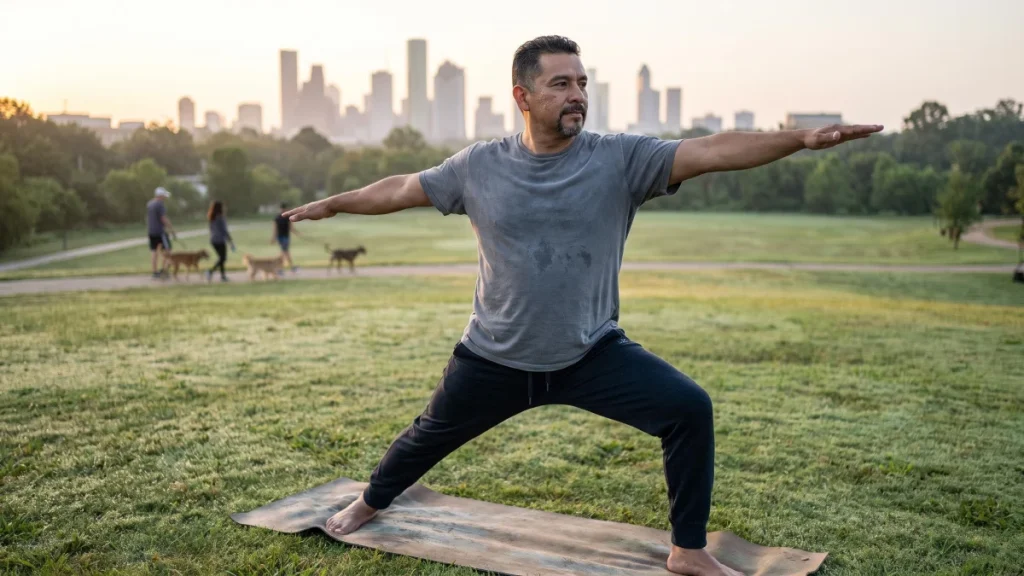
Short answer: Yoga for men is simply yoga done with the stiff hips, tight hamstrings and desk posture most men actually have. Research summarized by the National Center for Complementary and Integrative Health (NCCIH) shows a slight to moderate benefit for chronic low back pain, consistent benefits for perceived stress in reviews, and some benefit for sleep quality in certain groups. Eight basic poses, practiced for 15 to 20 minutes three times a week, are enough to start.
Key Takeaways
- You do not need to be flexible to start. Beginner yoga for men works with your current range of motion, not the one in photos.
- NCCIH reviews find yoga gives a slight benefit for chronic low back pain, similar to other exercise and massage, and the American College of Physicians lists it as an initial option for chronic low back pain.
- A review of 12 studies found yoga lowered perceived stress in every study included; evidence for sleep is more mixed but leans positive for sleep quality.
- Most yoga injuries are sprains and strains. Beginners should skip headstands, shoulder stands, the lotus position and forceful breathing.
- Short, regular sessions beat one long weekly class. Pair yoga with strength training and walking rather than replacing them.
Why Yoga Works Well for Men
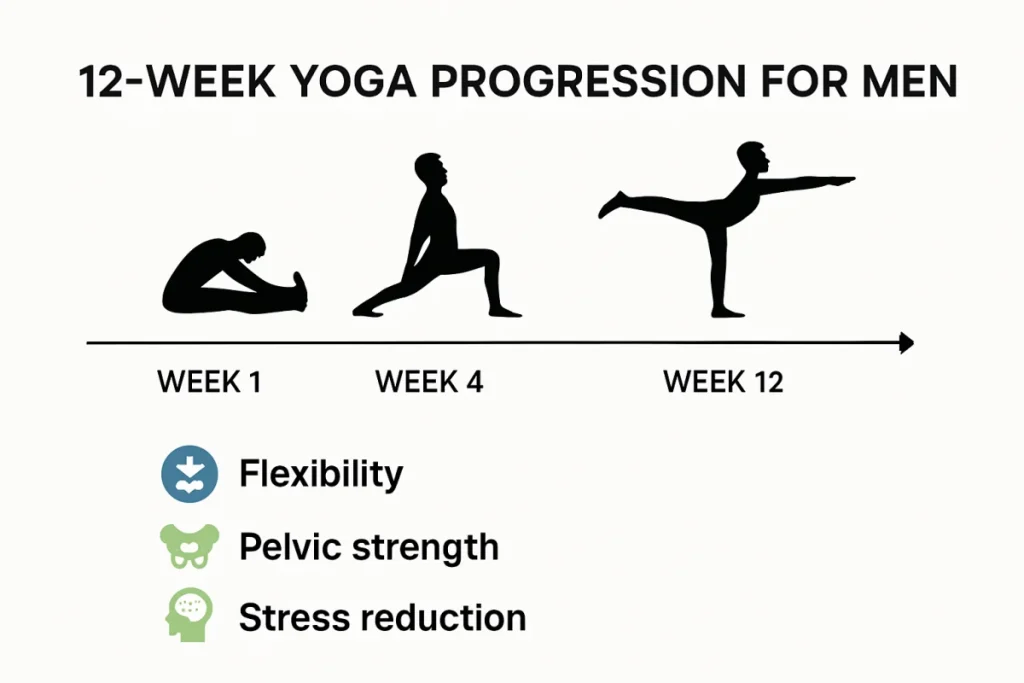
Most men come to yoga for one of three reasons: something hurts (usually the lower back or hips), stress is running high, or sleep is poor. Long hours of sitting shorten the hip flexors and hamstrings, round the upper back and leave the glutes underused. Lifting and running without mobility work can make this worse. Yoga combines slow, controlled movement, held positions and paced breathing, which is why it addresses all three problems at once.
Yoga is also a form of physical activity in its own right. In a small study described by Harvard Health Publishing, sedentary adults who were new to yoga had greater muscle strength and endurance, flexibility and cardiorespiratory fitness after eight weeks of practice.[3] That does not make yoga a replacement for lifting or cardio, but it is a real training stimulus for beginners.
What “yoga for men” is not
It is not a different discipline. The poses are the same ones taught in any beginner class. The difference is emphasis: more hip, hamstring and thoracic spine work, more props (blocks, a strap, a pillow), and less pressure to reach end ranges. If a pose demands flexibility you do not have yet, you modify it. That is the whole method.
What the Research Shows on the Benefits of Yoga for Men
Most yoga studies include both men and women, so the findings below apply to adults in general. Here is what the evidence actually supports, based on NCCIH summaries of the research.
Low back pain
This is the best studied use of yoga. NCCIH reports that “a large amount of research has been done, and the evidence suggests a slight benefit.” A 2022 review of 21 studies with 2,223 participants found yoga slightly better than no exercise, although the difference may be small from a patient’s point of view. A 2020 Agency for Healthcare Research and Quality report of 10 studies with 1,520 participants found yoga improved pain and function at 1 to 6 months and at 6 to 12 months, with effects similar to exercise and massage.[1] NCCIH also notes that the American College of Physicians guideline includes yoga as an option for initial treatment of chronic low back pain.[2]
Neck pain
A 2019 review of 10 studies with 686 participants found yoga reduced neck pain intensity and neck related disability and improved neck range of motion.[1] For men who spend the day looking down at a phone or laptop, that is a practical finding.
Stress and anxiety
A 2020 review of 12 studies with 672 participants found beneficial effects on perceived stress in all the studies. A 2019 review of 38 studies with 2,295 participants found a substantial beneficial effect on anxiety. In a 2021 NCCIH supported trial in generalized anxiety disorder, yoga improved symptoms but was less helpful than cognitive behavioral therapy.[1] In other words, yoga is a useful stress tool, not a substitute for treatment of an anxiety disorder. For the hormone side of stress, see our guide on how to lower cortisol.
Sleep
The sleep evidence is promising but less clear. NCCIH says yoga has been helpful for sleep in multiple studies of cancer patients, women with sleep problems and older adults.[1] A 2019 review of 4 studies in 353 older adults found a small to moderate positive effect on sleep quality, while a 2019 VA/DoD guideline found insufficient evidence to recommend for or against yoga as a treatment for insomnia.[4] Cognitive behavioral therapy for insomnia (CBT-I) remains the most strongly recommended treatment. The fair takeaway: a calm evening routine that includes gentle yoga may help you sleep better, but persistent insomnia deserves a proper evaluation. Our article on the best sleep routines for men covers the rest of the routine.
Heart and metabolic health
Harvard Health Publishing describes several small studies in which yoga helped lower blood pressure in people with hypertension and improved lipid profiles, and notes that yoga is now included in many cardiac rehabilitation programs.[3] NCCIH also cites a 2022 review of 22 studies in which yoga was associated with reductions in body weight, BMI, body fat and waist size.[1] These studies are smaller and more varied than the back pain research, so treat them as encouraging rather than settled.
8 Yoga Poses for Men Who Are Beginners
These poses target the areas that tighten most with sitting, driving and lifting. The hold times are starting points, not targets. Breathe slowly through your nose and stop at a mild stretch, never pain.
| Pose | Target area | How long (to start) | Beginner modification |
|---|---|---|---|
| Cat cow | Spine, lower back | 8 to 10 slow rounds | Pad your knees with a folded towel; keep the movement small |
| Child’s pose | Lower back, hips, shoulders | 5 to 10 breaths | Knees wide, forehead on a block or pillow, or a pillow under the hips |
| Low lunge | Hip flexors, quads | 5 breaths per side | Back knee on a cushion, hands on blocks, shorten the stance |
| Downward dog | Hamstrings, calves, shoulders | 3 to 5 breaths | Bend the knees generously; hands on a chair seat if wrists or shoulders complain |
| Bridge | Glutes, back of the thighs | 5 holds of 3 to 5 breaths | Lift only partway; keep weight off the neck |
| Figure 4 stretch (reclined pigeon) | Deep hip rotators, glutes | 5 to 8 breaths per side | Keep the bottom foot on the floor instead of pulling the leg in |
| Cobra (or sphinx) | Upper back, chest | 3 to 5 breaths, repeat 3 times | Use sphinx (on forearms) for a gentler back bend |
| Legs up the wall | Relaxation, calves, hamstrings | 2 to 5 minutes | Move your hips a little away from the wall if hamstrings are tight |
Safety cues for every pose
- Breathe, do not hold your breath. If you cannot breathe smoothly, you are pushing too hard.
- Bend your knees in forward folds. Rounding the lower back to reach the floor with straight legs is a common way to strain it.
- Protect the knees. In lunges, keep the front knee over the ankle, not drifting inward, and pad the back knee.
- Keep the neck neutral. In bridge, do not turn your head while your hips are lifted.
- Skip advanced positions at first. NCCIH advises beginners to avoid headstands, shoulder stands, the lotus position and forceful breathing.[1]
- Be careful with hot yoga. It carries extra risks of overheating and dehydration.[1]
A Simple Weekly Yoga Routine for Men
Consistency matters more than intensity. Three short sessions plus one longer evening wind down is a realistic plan for a busy week.
| Day | Session | Time | Focus |
|---|---|---|---|
| Monday | Cat cow, low lunge, downward dog, bridge, child’s pose | 15 minutes | Hips and back after the weekend |
| Wednesday | Cat cow, figure 4 stretch, cobra, bridge, child’s pose | 15 minutes | Glutes, upper back, posture |
| Friday | Full 8 pose flow from the table above | 20 minutes | Whole body mobility |
| Sunday evening | Child’s pose, figure 4 stretch, legs up the wall, slow breathing | 10 to 15 minutes | Wind down before sleep |
Start each session with a couple of minutes of slow breathing: inhale through the nose, then exhale a little longer than you inhaled. Paced breathing is a core part of yoga and is the piece most men skip. On other days, keep your usual strength training and walking. If you want a simple way to track progress beyond flexibility, a grip strength check is an easy home marker of overall strength.
How to progress
After three or four weeks, if the poses feel easy, add a few breaths to each hold, try a beginner class with a qualified instructor, or add a second round of the flow. Progress shows up as easier movement, such as tying your shoes standing or getting off the floor without using your hands, more than as touching your toes.
Who Should Talk to a Doctor First
NCCIH describes yoga as generally safe for healthy people when performed properly under the guidance of a qualified instructor. The most common injuries are sprains and strains, and serious injuries are rare. Emergency department visits for yoga injuries are more common in people aged 65 and older.[1] Conditions that may call for modified poses include:
- Preexisting injuries, especially of the knee, shoulder or neck
- Lumbar spine disease, such as a herniated disc
- Severe high blood pressure
- Balance problems
- Glaucoma (head down positions can be an issue)
If any of these apply, talk to your doctor or physical therapist and tell your instructor before starting. New, severe or radiating back pain, numbness or weakness should be checked by a clinician rather than stretched out at home.
Where Supplements Fit (and Where They Do Not)
No supplement replaces movement, sleep and stress management. Yoga, walking and strength training are the foundation. Some men also choose a botanical supplement as part of their routine. Ultra Bann, made by DL Bioproducts, is one capsule every 2 days with seven botanicals listed by amount on the label (Thai Butea superba, Panax ginseng, Cynomorium songaricum, black ginger, tongkat ali, epimedium and reishi) and no proprietary blend. You can see the full ingredient label or visit the Ultra Bann shop. First orders include free US shipping and a 60-day money-back guarantee.
Frequently Asked Questions
Is yoga good for men?
Yes. The research behind yoga applies to adults in general, and the evidence is strongest for chronic low back pain, neck pain and perceived stress. Men often benefit most from the hip and hamstring work, since those areas tighten with sitting and lifting.
Can a man who is not flexible do yoga?
Yes, and that is exactly who beginner yoga is for. Bend your knees, use blocks or a pillow, and work within your current range. Flexibility improves with regular practice; it is not a requirement to start.
How often should a beginner man do yoga?
Three short sessions a week of 15 to 20 minutes is a realistic start. Regular short sessions are easier to keep up and gentler on the body than one long weekly class.
Does yoga build muscle?
Yoga builds some strength and endurance, especially for beginners, as shown in a small study of sedentary adults described by Harvard Health. It does not replace progressive strength training if your goal is to build muscle, so most men do best combining the two.
What is the best yoga pose for tight hips?
For most beginners, the low lunge (for the front of the hip) and the reclined figure 4 stretch (for the back of the hip) are the most useful and easiest to control. Hold each for a few slow breaths per side and avoid forcing the knee.
References
- National Center for Complementary and Integrative Health. Yoga: What You Need To Know. Last updated August 2023.
- National Center for Complementary and Integrative Health. Low-Back Pain and Complementary Health Approaches: What You Need To Know. Last updated January 2020.
- Harvard Health Publishing. Yoga: Benefits Beyond the Mat. Last modified July 2024.
- National Center for Complementary and Integrative Health. Sleep Disorders and Complementary Health Approaches: Usefulness and Safety. Last updated May 2024.
These statements have not been evaluated by the Food and Drug Administration. This product is not intended to diagnose, treat, cure or prevent any disease. This article is for information only and is not medical advice.
Ultra Bann natural male vitality support
1 capsule every 2 days. Free US shipping and a 60-day money-back guarantee on your first order.
See Ultra BannThese statements have not been evaluated by the Food and Drug Administration. This product is not intended to diagnose, treat, cure, or prevent any disease.