
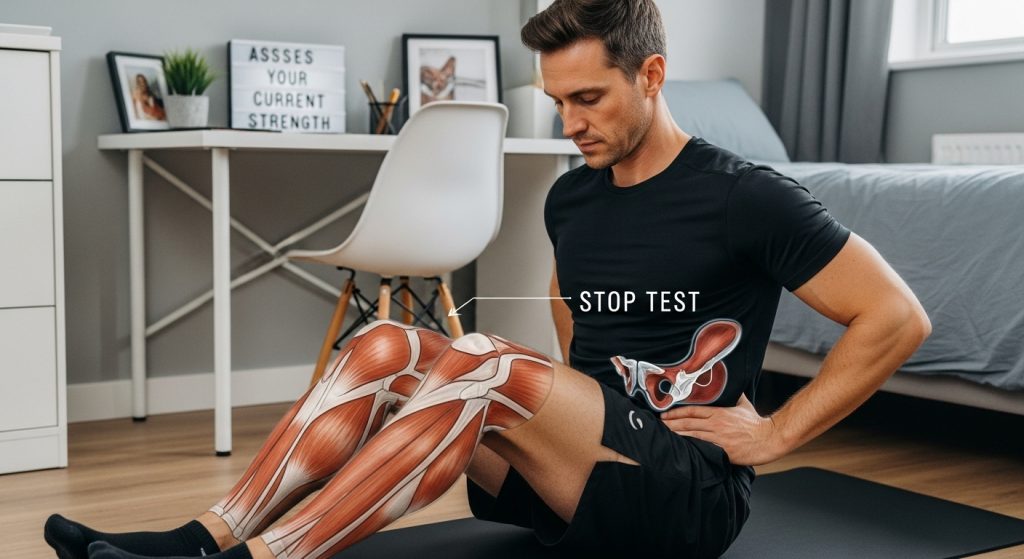
Short answer: Kegel exercises for men strengthen the pelvic floor, the sling of muscle under the bladder and around the base of the penis and the anus. Find the muscles by squeezing as if you were holding in gas, then tighten and lift for 3 to 5 seconds, relax for the same time, and repeat about 10 times, three times a day. Mayo Clinic and MedlinePlus say most men notice less leaking or dribbling within a few weeks to a few months, and the best evidence is for bladder control after prostate surgery.
Key Takeaways
- The pelvic floor muscles are the ones you use to stop passing gas or to stop urinating midstream. A correct squeeze lifts the scrotum slightly and draws the base of the penis inward.
- A simple starting routine is a 3 to 5 second squeeze, a 3 to 5 second rest, 10 repetitions, three times a day (MedlinePlus), working toward longer holds of up to 10 seconds plus quick 1 second squeezes (Prostate Cancer UK).
- Kegels may help with after-dribble, stress and urge leakage, and leaking after a radical prostatectomy. A 2019 systematic review of 8 randomized trials concluded pelvic floor training is effective for incontinence after prostate removal.
- Evidence for sexual function is promising but mixed. Mayo Clinic says Kegels may improve sexual function, while trials in men having prostate surgery have often found no clear erectile benefit.
- The most common mistakes are squeezing the buttocks, thighs or stomach, holding your breath, pushing down instead of lifting, and doing Kegels while urinating.
- If you cannot feel the muscles working, or nothing improves after about three months, ask for a referral to a pelvic floor physical therapist.
What Are Kegel Exercises for Men?
Kegel exercises, also called pelvic floor exercises or pelvic floor muscle training, are repeated voluntary contractions of the muscles that support the bladder and bowel. In men these muscles wrap around the urethra and the rectum and attach at the base of the penis. They help keep urine in when pressure rises in the abdomen, help push out the last drops of urine after you go, and contribute to normal sexual function.
Like any other skeletal muscle, the pelvic floor can lose strength. Mayo Clinic lists several factors that weaken it in men: surgery to remove the prostate (radical prostatectomy), overactive bladder, aging, being overweight, and repeated straining from constipation or a chronic cough.[1] Male pelvic floor training is not a gym move you can see in a mirror, which is exactly why technique matters more than effort.
Who tends to use them
- Men with dribbling after urinating (post-void or post-micturition dribble).
- Men with stress leakage when they cough, sneeze, laugh or lift.
- Men with urge leakage, where a sudden strong urge comes before reaching the toilet.
- Men preparing for, or recovering from, prostate surgery or prostate radiotherapy.
- Men who simply want better control and awareness of these muscles.
How to Find Your Pelvic Floor Muscles
Getting the right muscle is the hardest part. Try these methods from Mayo Clinic, MedlinePlus and Prostate Cancer UK:[1][2][3]
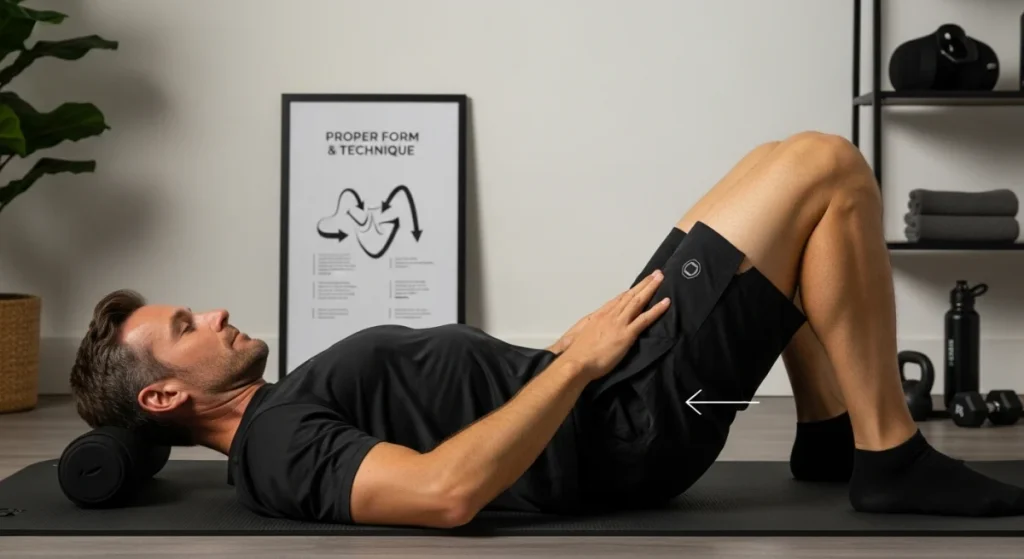
- The gas test. Sit or lie down and tighten the ring of muscle around your anus as if you were trying not to pass wind. Keep your buttocks, thighs and stomach relaxed and keep breathing.
- The mirror or touch check. When you squeeze correctly you should see the base of the penis dip slightly and the scrotum lift. If you place your fingers on the skin behind the scrotum, the muscles should lift away from your fingers.
- The finger check. Mayo Clinic and MedlinePlus describe inserting a finger into the rectum and squeezing as if holding in urine. A sense of tightening and lifting around the finger means you have the right muscles.
- The midstream stop (only as a one-time test). Stopping your urine flow once can show you which muscles to use. Do not make it a habit: Mayo Clinic warns that doing Kegels while urinating can raise the risk of a bladder infection, and MedlinePlus advises not doing it more than twice a month.
If the area bulges or pushes down when you squeeze, you are bearing down rather than lifting. Prostate Cancer UK says that means the exercise is not being done correctly.[3]
Step-by-Step Kegel Routine for Men
Each source gives slightly different numbers, so the table below lays them out side by side. Start at the beginner level, then progress as the squeezes get easier. Mayo Clinic suggests starting lying down, then moving to sitting, standing and walking as the muscles get stronger.[1]
| Stage | Hold | Relax | Reps per set | Sets per day | Position | Source |
|---|---|---|---|---|---|---|
| Beginner | 3 seconds | 3 seconds | Several, building to 10 to 15 | At least 3 | Lying down | Mayo Clinic[1] |
| Standard routine | 3 to 5 seconds | 3 to 5 seconds | 10 | 3 (morning, afternoon, night) | Sitting or lying, bladder empty | MedlinePlus[2] |
| Slow holds (strength) | Up to 10 seconds | 10 seconds | Up to 10 | About 3 | Lying, sitting, then standing | Prostate Cancer UK[3] |
| Fast squeezes (reflex) | 1 second | Let go fully | Up to 10 | About 3, after the slow holds | Any | Prostate Cancer UK[3] |
| Functional “knack” | Squeeze just before and during the effort | Relax after | As needed | In daily life | Coughing, sneezing, lifting, after urinating | Mayo Clinic, Prostate Cancer UK[1][3] |
A simple daily plan
- Morning: one set lying in bed before you get up (slow holds, then fast squeezes).
- Midday: one set sitting at your desk or in the car.
- Evening: one set standing, for example while brushing your teeth. Mayo Clinic suggests tying sets to routine tasks so you do not forget them.
- Every time you urinate: once you have finished, give one firm squeeze to clear the last drops from the urethra.
If you cannot hold for 10 seconds at first, hold for as long as you can and build up over the weeks. MedlinePlus adds a useful limit: once symptoms improve, keep going but do not keep raising the number of repetitions, because overdoing it can lead to straining when you urinate or have a bowel movement.[2]
How long until Kegels work?
Expect gradual change. Mayo Clinic says results such as less frequent leaking may appear within a few weeks to a few months. MedlinePlus says you should have fewer symptoms after 4 to 6 weeks but that incontinence can take several months to improve. Prostate Cancer UK says it can take up to three months to see a real difference.[1][2][3] All three agree on one point: the benefit fades if you stop, so the routine is a long-term habit, even if you need fewer sets once the muscles are strong.
What the Evidence Shows
Leaking after prostate surgery (strongest evidence)
Urinary leakage after radical prostatectomy is the most studied reason for men to train the pelvic floor. A systematic review in Clinical Interventions in Aging (2019) pooled 8 randomized controlled trials with 1,078 men aged 45 to 75 and concluded that pelvic floor muscle training is effective for incontinence after prostate removal and also improves quality of life.[4] In one randomized trial in the American Journal of Men’s Health (2018), 60 men having robot-assisted prostatectomy were split into a group that did pelvic floor exercises three times daily for 6 months and a group that did not; incontinence questionnaire scores fell over time, with significant reductions at months 3 and 6.[4]
Timing matters. Prostate Cancer UK advises starting four to six weeks before surgery, not exercising while a urinary catheter is still in place, and restarting once it is removed. It also says the exercises are safe during and after radiotherapy.[3]
Gadgets are a different question. A 2023 systematic review in PLOS ONE looked at whether adding devices such as biofeedback or electrical or magnetic stimulation to pelvic floor training helps after prostatectomy. It found 11 randomized trials, most at high risk of bias, rated the certainty of evidence as very low, and could not determine whether the devices add value.[5] In practice, correct technique and consistency seem to matter more than equipment.
Dribbling after urinating
Both Mayo Clinic and Prostate Cancer UK recommend tightening the pelvic floor right after you finish urinating to clear the urethra and reduce dribbling.[1][3] Researchers have also tested pelvic floor exercises specifically for post-micturition dribble, including a study in Urologic Nursing (2004) in men who also had erectile difficulties.[6]
Sexual function (mixed evidence)
Mayo Clinic says Kegels may also improve sexual function, and Prostate Cancer UK says the exercises may help some men get or keep an erection.[1][3] An early randomized controlled trial in the British Journal of General Practice (2004) tested pelvic floor exercises with biofeedback for erectile dysfunction.[6]
The picture is less clear after prostate surgery. A 2025 systematic review in Uro found only 3 eligible studies on training before prostatectomy: both randomized trials showed no significant effect on erectile function afterward, and only a non-randomized study reported a benefit.[7] A randomized trial of 97 men in Sexual Medicine (2020), comparing 3 sets a day with 6 standing sets a day starting 5 weeks before surgery, found no conclusive erectile benefit and noted its sample was too small to show one.[8] The honest summary: Kegels are low risk and may help, but erectile problems deserve a medical check because they can have underlying causes a doctor should look for. See our guide on enlarged prostate and erectile function for more on when to see a doctor.
Common Kegel Mistakes Men Make
- Squeezing the wrong muscles. Clenching the buttocks, thighs or stomach feels like hard work but does little for the pelvic floor. Put a hand on your belly; it should stay soft.[1][3]
- Holding your breath. Breathe normally through every hold.[1][2]
- Pushing down instead of lifting. The feeling should be “squeeze and lift up and in,” never bearing down.[3]
- Exercising while urinating. Use the midstream stop only as an occasional test.[1][2]
- Doing too many. Tired muscles leak more, which is why Prostate Cancer UK notes leakage can be worse later in the day, and MedlinePlus warns against constantly adding repetitions.[2][3]
- Not relaxing fully between squeezes. The relax phase is part of the exercise. Let the muscle drop all the way before the next rep.
- Quitting too early. Most sources describe improvement over weeks to months, not days.
When to See a Doctor or Pelvic Floor Physical Therapist
Mayo Clinic recommends talking with a healthcare professional before starting, to make sure Kegels suit your situation, and asking for help if you struggle with them.[1] A pelvic floor physical therapist (in the UK often called a men’s health physiotherapist or continence advisor) can check your technique and build a program for you.[2][3] Book an appointment if:
- You are not sure you can feel the muscles lift, or you only feel bearing down.
- Leaking has not improved after about three months of regular practice.
- You are scheduled for prostate surgery or radiotherapy and want to start training beforehand.
- You have pelvic, genital or rectal pain, or the exercises themselves cause pain.
- You notice new urinary symptoms such as blood in the urine, a weak stream, frequent night urination or trouble emptying your bladder. These need a medical evaluation, not just exercise. Our overview of prostate health and enlarged prostate symptoms explains what a doctor may check.
A clinician may also offer biofeedback, where a small sensor shows how hard you are squeezing, or electrical stimulation, which uses a mild current to make the muscles contract.[1]
Kegels and Your Overall Fitness
The pelvic floor works with your deep core and breathing. Staying active, keeping a healthy weight, treating constipation and a chronic cough, and doing general strength work all reduce the load these muscles have to manage, which ties back to the risk factors Mayo Clinic lists.[1] If you want to build a broader routine, see our bodyweight workouts for men and how to increase stamina.
Some men also take a daily supplement as part of their wellness routine. Ultra Bann, made by DL Bioproducts, is a natural male vitality supplement taken as one capsule every 2 days, with seven botanicals listed on the label. It is not a replacement for pelvic floor training or for seeing a clinician about urinary or sexual symptoms. You can review the full label and the Ultra Bann shop page if you want details.
Frequently Asked Questions
How many Kegels should a man do a day?
A common target is about 30 a day, split into three sets of 10. MedlinePlus recommends 10 repetitions three times a day, and Mayo Clinic suggests at least three sets daily, building up to 10 to 15 squeezes per set. More is not always better, because tired muscles can work worse.
How do I know if I am doing Kegels correctly?
You should feel the area around the anus tighten and lift, the base of the penis draw in slightly and the scrotum rise. Your stomach, buttocks and thighs should stay relaxed and you should be able to breathe normally. If you feel pushing down, or you are unsure, ask for a pelvic floor physical therapy assessment.
Can Kegels stop dribbling after peeing?
They often help. Mayo Clinic and Prostate Cancer UK both recommend a firm pelvic floor squeeze right after you finish urinating to clear the last drops from the urethra, alongside regular daily sets.
Do Kegels help with erections?
They may. Mayo Clinic says Kegels may improve sexual function, but studies in men recovering from prostate surgery have shown mixed results. Because erectile problems can be linked to blood vessel, hormone or nerve issues, see a doctor rather than relying on exercise alone.
Can you do too many Kegels?
Yes. MedlinePlus warns that overdoing the exercises can lead to straining with urination or bowel movements, and Prostate Cancer UK notes that fatigued muscles can lead to more leaking later in the day. If Kegels cause pain, stop and get checked.
References
- Kegel exercises for men. Mayo Clinic. mayoclinic.org
- Kegel exercises: self-care. MedlinePlus Medical Encyclopedia, U.S. National Library of Medicine. medlineplus.gov
- Pelvic floor muscle exercises. Prostate Cancer UK. prostatecanceruk.org
- The impact of pelvic floor muscle training on urinary incontinence in men after radical prostatectomy (RP): a systematic review. Clinical Interventions in Aging. 2019;14:1997 to 2005. DOAJ record. Also cited: The effect of pelvic floor muscle training on incontinence problems after radical prostatectomy. American Journal of Men’s Health. 2018. doi:10.1177/1557988318757242
- The added value of devices to pelvic floor muscle training in radical post-prostatectomy stress urinary incontinence: a systematic review with metanalysis. PLOS ONE. 2023;18(9):e0289636. doi:10.1371/journal.pone.0289636
- PubMed records: Randomised controlled trial of pelvic floor muscle exercises and manometric biofeedback for erectile dysfunction. Br J Gen Pract. 2004 (PMID 15527607); Pelvic floor exercises for treating post-micturition dribble in men with erectile dysfunction. Urol Nurs. 2004 (PMID 15658735). pubmed.ncbi.nlm.nih.gov
- Effect of preoperative pelvic floor muscle training on erectile dysfunction after radical prostatectomy: a systematic review. Uro. 2025;6(1). doi:10.3390/uro6010002
- Pelvic floor muscle training and erectile dysfunction in radical prostatectomy: a randomized controlled trial investigating a non-invasive addition to penile rehabilitation. Sexual Medicine. 2020;8(3). doi:10.1016/j.esxm.2020.03.005
These statements have not been evaluated by the Food and Drug Administration. This product is not intended to diagnose, treat, cure or prevent any disease. This article is for information only and is not medical advice.
Ultra Bann natural male vitality support
1 capsule every 2 days. Free US shipping and a 60-day money-back guarantee on your first order.
See Ultra BannThese statements have not been evaluated by the Food and Drug Administration. This product is not intended to diagnose, treat, cure, or prevent any disease.