
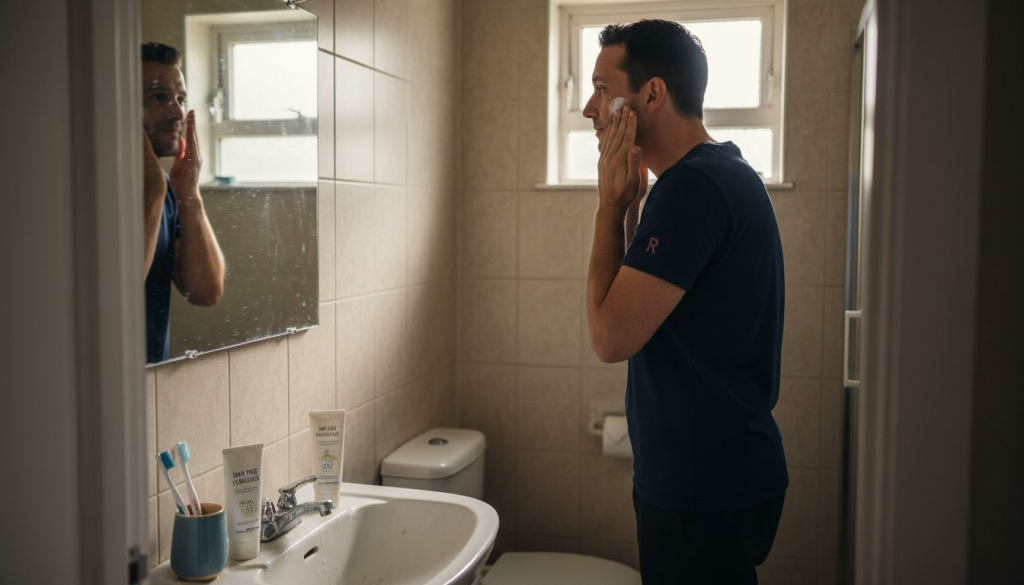
Short answer: Good skin care for men comes down to three daily habits: wash your face gently (morning, night and after sweating), moisturize while your skin is still slightly damp, and use a broad-spectrum sunscreen with SPF 30 or higher every day. Add a monthly skin self-check for new or changing spots. Everything else, from serums to retinoids, is optional and should match your skin type.
Key Takeaways
- A complete men’s skincare routine needs only three products to start: a gentle alcohol-free cleanser, a moisturizer and a broad-spectrum SPF 30+ sunscreen.[1][3]
- Dermatologists advise washing no more than twice a day plus after sweating, with lukewarm water and fingertips, not scrubbing.[1]
- Sunscreen is the single highest-value step: the American Academy of Dermatology (AAD) recommends SPF 30 or higher, broad spectrum and water resistant.[3]
- Skin cancer is common (an estimated one in five Americans will develop it), so regular self-exams using the ABCDEs of melanoma are part of basic skin care.[4][5]
- Retinoids are the best-known anti-aging ingredient, but they can irritate skin; stronger versions need a prescription, so a dermatologist is the right guide.[6]
- Not smoking, managing stress and sleeping well show up on your face as much as any product does.[2]

Why Skin Care for Men Matters (Beyond Looks)
Skin is your largest organ and your first barrier against sun, pollution, heat and friction. For most men, the real goals of a skincare routine are practical: fewer breakouts and ingrown bumps, less dryness and flaking, slower visible aging and, most importantly, lower long-term sun damage.
That last point is not cosmetic. The AAD estimates that one in five Americans will develop skin cancer in their lifetime, and notes that checking your skin regularly helps catch it early, when it is highly treatable.[4] Daily sunscreen and simple self-checks are the two habits that protect you the most, and they cost very little time.
Men also tend to skip the basics: washing with harsh bar soap, using very hot showers, never moisturizing and treating sunscreen as a beach-only product. Fixing those few habits usually changes skin more than buying expensive products.
A Simple Men’s Skincare Routine: Morning and Night
A good skincare routine for men should take two to three minutes. Start with the core steps below for a few weeks before adding anything else, so you can tell what is helping and what is irritating your skin.
| Step | Morning (AM) | Night (PM) | What to look for |
|---|---|---|---|
| 1. Cleanse | Wash with lukewarm water and a gentle cleanser | Wash again to remove sweat, oil, dirt and sunscreen | Gentle, non-abrasive, alcohol-free[1] |
| 2. Treat (optional) | Vitamin C or niacinamide serum if you want one | Retinoid, or an acne product if needed | Introduce one new product at a time |
| 3. Moisturize | Light lotion or gel, especially after shaving | Lotion or cream, richer if skin is dry | Non-comedogenic if you break out |
| 4. Protect | Broad-spectrum sunscreen, SPF 30 or higher | Not needed | Broad spectrum, SPF 30+, water resistant for sweat or water[3] |
Step 1: Cleanse gently
The AAD’s face-washing advice is simple: use a gentle, non-abrasive cleanser that does not contain alcohol, wet your face with lukewarm water, apply the cleanser with your fingertips, resist the urge to scrub, rinse and pat dry with a soft towel.[1] Limit washing to twice a day and after sweating; if you sweat under a hat or helmet, wash as soon as you can, because trapped sweat irritates skin.[1]
Washcloths, rough sponges and gritty scrubs feel like they are “deep cleaning,” but scrubbing irritates the skin. So does very hot water. Mayo Clinic suggests keeping baths and showers short (no longer than five minutes) and using warm, not hot, water.[2]
Step 2: Moisturize
Moisturizer holds water in the outer layer of the skin and reduces the tight, flaky feeling many men get after washing or shaving. The AAD recommends applying moisturizer if your skin is dry or itchy, and Mayo Clinic suggests patting skin dry rather than rubbing so some moisture stays on the skin.[1][2] If you have dry skin, a daily moisturizer with SPF can combine steps 3 and 4 in the morning.[2]
Step 3: Use sunscreen every day
This is the step most men skip, and the one with the biggest payoff. The AAD recommends a sunscreen that is SPF 30 or higher, labeled broad spectrum (protecting against both UVA and UVB rays) and water resistant. Water resistance lasts either 40 or 80 minutes, so check the label if you swim or sweat heavily.[3] Mayo Clinic adds: reapply every two hours, or more often if you are swimming or sweating, and seek shade between 10 a.m. and 4 p.m., when UV rays are strongest.[2]
Do not forget the areas men commonly miss: ears, back of the neck, the scalp if your hair is thin or short, and the tops of the hands. A wide-brimmed hat and tightly woven clothing help where sunscreen tends to wear off.[2]
Know Your Skin Type
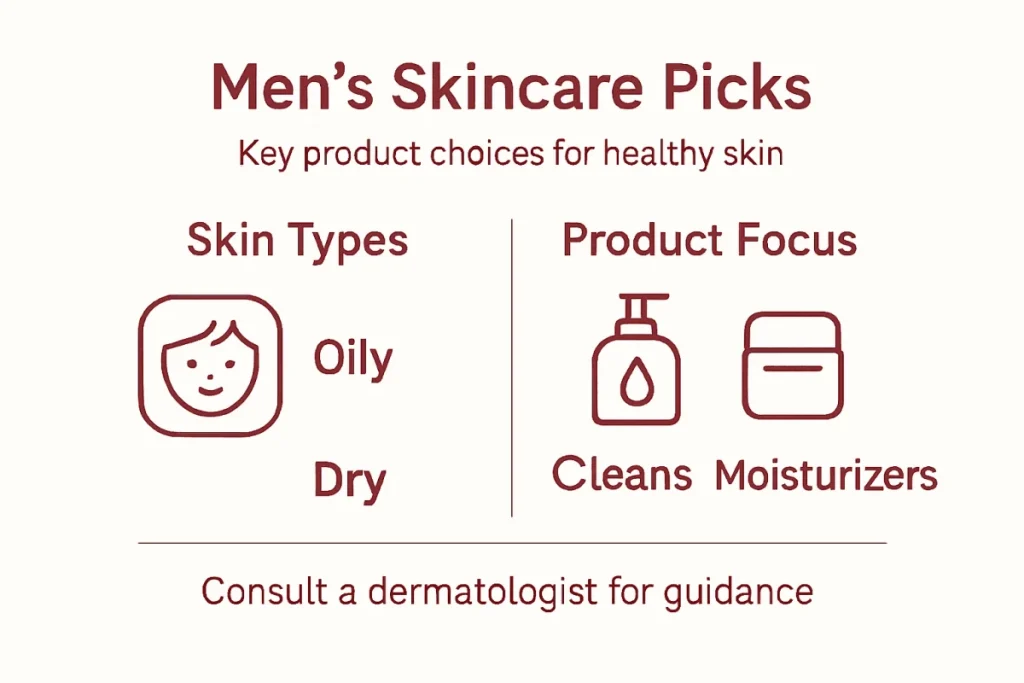
Choosing the right products is much easier once you know how your skin behaves. A practical check: wash your face with a gentle cleanser, apply nothing, and look at your skin a few hours later. Shine everywhere suggests oily skin; tightness or flakes suggests dry skin; shine only on the forehead, nose and chin (the T-zone) suggests combination skin. If many products sting, burn or turn your skin red, you likely have sensitive skin.
| Skin type | Common signs | Cleanser | Moisturizer | Watch out for |
|---|---|---|---|---|
| Oily | Shine by midday, enlarged pores, breakouts | Gentle foaming or gel cleanser | Light, oil-free, non-comedogenic lotion or gel | Over-washing and harsh astringents, which dry and irritate |
| Dry | Tightness, flakes, rough patches, itch | Creamy, non-foaming cleanser | Richer cream applied to slightly damp skin | Hot showers and alcohol-based aftershave |
| Combination | Oily T-zone, normal or dry cheeks | Gentle gel or lotion cleanser | Light lotion overall, extra on dry areas | Using strong oily-skin products on the whole face |
| Sensitive | Stinging, burning, redness with many products | Fragrance-free, minimal-ingredient cleanser | Fragrance-free, simple formula | Fragrance, scrubs, adding several new products at once |
Acne Basics for Men
Breakouts are not only a teenage problem. Sweat, helmets, hats, beard friction and heavy hair products can all contribute in adult men. The AAD’s acne skin care advice overlaps closely with the basic routine:[5]
- Wash up to twice daily and after sweating, with a gentle, non-abrasive cleanser and your fingertips.
- Choose products labeled alcohol-free, and skip astringents, toners and exfoliants, which can dry and irritate the skin.
- Use sunscreen labeled “non-comedogenic” or “won’t clog pores.”
- Do not pick, pop or squeeze breakouts, which can slow healing and raise the risk of scars and dark spots.
- Be patient: acne treatment can take several weeks to a few months to show results.
If over-the-counter products have not helped after that window, or if you have painful deep bumps, scarring or dark marks left behind, a board-certified dermatologist can offer prescription options.
Ingredients Worth Knowing
Once the basic routine is a habit, some men add a targeted product. These are the ingredients with the clearest role, based on Mayo Clinic’s overview of anti-aging creams:[6]
Retinoids (retinol and prescription retinoids)
Retinoids are made from vitamin A, and retinol is a milder type sold over the counter. The main side effect is irritation, which often lessens over time. Retinoids, including retinol, should not be used during pregnancy, which matters if you share products with a partner. Over-the-counter products often contain lower amounts of active ingredients than prescription versions, and stronger retinoids require a prescription from a healthcare professional.[6] A dermatologist can tell you whether a prescription retinoid makes sense for your skin and how to start it without excessive peeling. Use retinoids at night and keep up daily sunscreen.
Vitamin C
Used daily, vitamin C may help protect against sun and pollution damage and may improve skin tone. It can lose its strength when exposed to light, heat or air, so store it closed, in a cool dark place.[6] Vitamin C is a complement to sunscreen, not a replacement for it.
Niacinamide
Niacinamide is a form of vitamin B3 that may help reduce signs of aging and improve skin tone. It is generally well tolerated and fits easily into a morning or evening routine.[6]
How long until you see results?
Mayo Clinic notes that many skin products need to be used once or twice a day for up to six weeks before you notice a difference, and that skin will likely go back to how it looked before if you stop.[6] Price is not a reliable guide to effectiveness, so consistency matters more than brand.
Skin Cancer Self-Checks: The Step Most Men Skip
A skin self-exam takes about as long as a shower. The AAD’s method:[4]
- In a full-length mirror, look at the front and back of your body, then your left and right sides with arms raised.
- Bend your elbows and check your forearms, underarms, palms and fingernails.
- Check the backs of your legs and feet, the spaces between your toes, your toenails and the soles of your feet.
- Use a hand mirror for the back of your neck and your scalp (part your hair).
- Use a hand mirror to check your back and buttocks.
While you look, use the ABCDEs of melanoma:[5]
- A, Asymmetry: one half of the spot is unlike the other half.
- B, Border: irregular, scalloped or poorly defined edges.
- C, Color: varied shades of tan, brown or black, or patches of white, red or blue.
- D, Diameter: melanomas are usually greater than 6 millimeters (about the size of a pencil eraser), though they can be smaller.
- E, Evolving: a spot that looks different from the rest or is changing in size, shape or color.
The AAD advises seeing a board-certified dermatologist for any spot that is different from the others, or that changes, itches or bleeds.[4] A partner can help check your back and scalp. Skin checks also fit naturally into your regular health screenings for men.
Lifestyle Habits That Show Up on Your Skin
- Do not smoke. Mayo Clinic explains that smoking narrows the small blood vessels in the outer layers of skin, damages collagen and elastin, and raises the risk of squamous cell skin cancer.[2] See our guide on the benefits of quitting smoking.
- Manage stress. Stress can trigger breakouts and worsen other skin problems.[2] Practical tools are covered in stress symptoms in men.
- Sleep enough. Mayo Clinic lists adequate sleep among its stress-management steps for healthier skin.[2] If sleep is the weak link, start with these sleep routines for men.
- Eat well. A diet rich in fruits, vegetables, whole grains and lean protein supports overall health. The link between diet and acne is not clear, so do not expect food changes alone to clear breakouts.[2]
Where Ultra Bann Fits
Ultra Bann is not a skin care product. It is a natural male vitality supplement by DL Bioproducts, taken as one capsule every 2 days, with seven botanicals listed with their exact amounts on the label (Thai Butea superba, Panax ginseng, Cynomorium songaricum, black ginger, tongkat ali, epimedium and reishi; 800 mg total, no proprietary blend). You can review the full ingredient label or see it in the Ultra Bann shop, where first orders include free US shipping and a 60-day money-back guarantee. For your skin, the routine above (cleanser, moisturizer, daily sunscreen and regular self-checks) is what does the work.
Frequently Asked Questions
What is the most basic skincare routine for men?
Wash your face with a gentle cleanser in the morning and at night, apply moisturizer, and use a broad-spectrum SPF 30+ sunscreen every morning. That three-product routine covers most of what dermatologists recommend for daily care.
Should men use different skincare products than women?
Not necessarily. Skin type matters far more than gender. Men often have more facial oil and deal with shaving irritation, so oil-free moisturizers and fragrance-free products can be good choices, but a gentle cleanser, moisturizer and sunscreen work the same for everyone.
How often should a man wash his face?
The AAD advises limiting face washing to twice a day, plus after sweating. Washing more often, or scrubbing, can strip and irritate the skin.
Do men really need sunscreen every day?
Yes. UV exposure happens on commutes, at work sites, on golf courses and through everyday errands, not only at the beach. Daily SPF 30+ broad-spectrum sunscreen reduces sunburn and long-term sun damage, and reapplying every two hours matters when you are outdoors for long periods.
When should a man see a dermatologist?
See a board-certified dermatologist for any spot that is new, different from your other moles, changing, itching or bleeding; for acne that has not improved after several weeks to a few months of over-the-counter care; or if you want to start a prescription retinoid.
References
- American Academy of Dermatology. Face washing 101.
- Mayo Clinic Staff. Skin care tips for healthy skin (Healthy lifestyle: adult health). Mayo Clinic.
- American Academy of Dermatology. How to select sunscreen.
- American Academy of Dermatology. Skin self-exam: how to check your skin.
- American Academy of Dermatology. ABCDEs of melanoma; and Acne skin care tips.
- Mayo Clinic Staff. Wrinkle creams (in-depth article on anti-aging ingredients). Mayo Clinic.
These statements have not been evaluated by the Food and Drug Administration. This product is not intended to diagnose, treat, cure or prevent any disease. This article is for information only and is not medical advice.
Ultra Bann natural male vitality support
1 capsule every 2 days. Free US shipping and a 60-day money-back guarantee on your first order.
See Ultra BannThese statements have not been evaluated by the Food and Drug Administration. This product is not intended to diagnose, treat, cure, or prevent any disease.